Afterimages
I thought maybe I would take a break from blogging in December. I thought this while looking at my calendar and trying to figure out when I could schedule in sweeping the floors. Grumbling to myself as I sprinted out the door, late for work, I wondered if it even counted if all my stress was self-inflicted. More form rejections, etc. The imperceptible dent my writing makes in the world, how unnoticeable the difference is, zoomed out, between my writing existing and not existing.
At work a man told me his daughter’s class went on a field trip today via ferry boat despite the below-freezing temperatures. She had to wear her school uniform, he said, her little Mary Janes. I was thinking about fragments and notes and writing on the go. If it was possible to write while walking or sweeping or working or grocery shopping or if this sort of scattered, stretched attention was antithetical to real writing. A writer I admire said in an interview that reading was an “experience of slowness,” so shouldn’t writing also be? But what if these wispy, frantic sentences, which I type into my phone in the middle of service, hiding behind the server station out of sight of guests and managers and coworkers clearing my tables for me, are all I have? If this is the only kind of writing that could fit into the demands of the day?
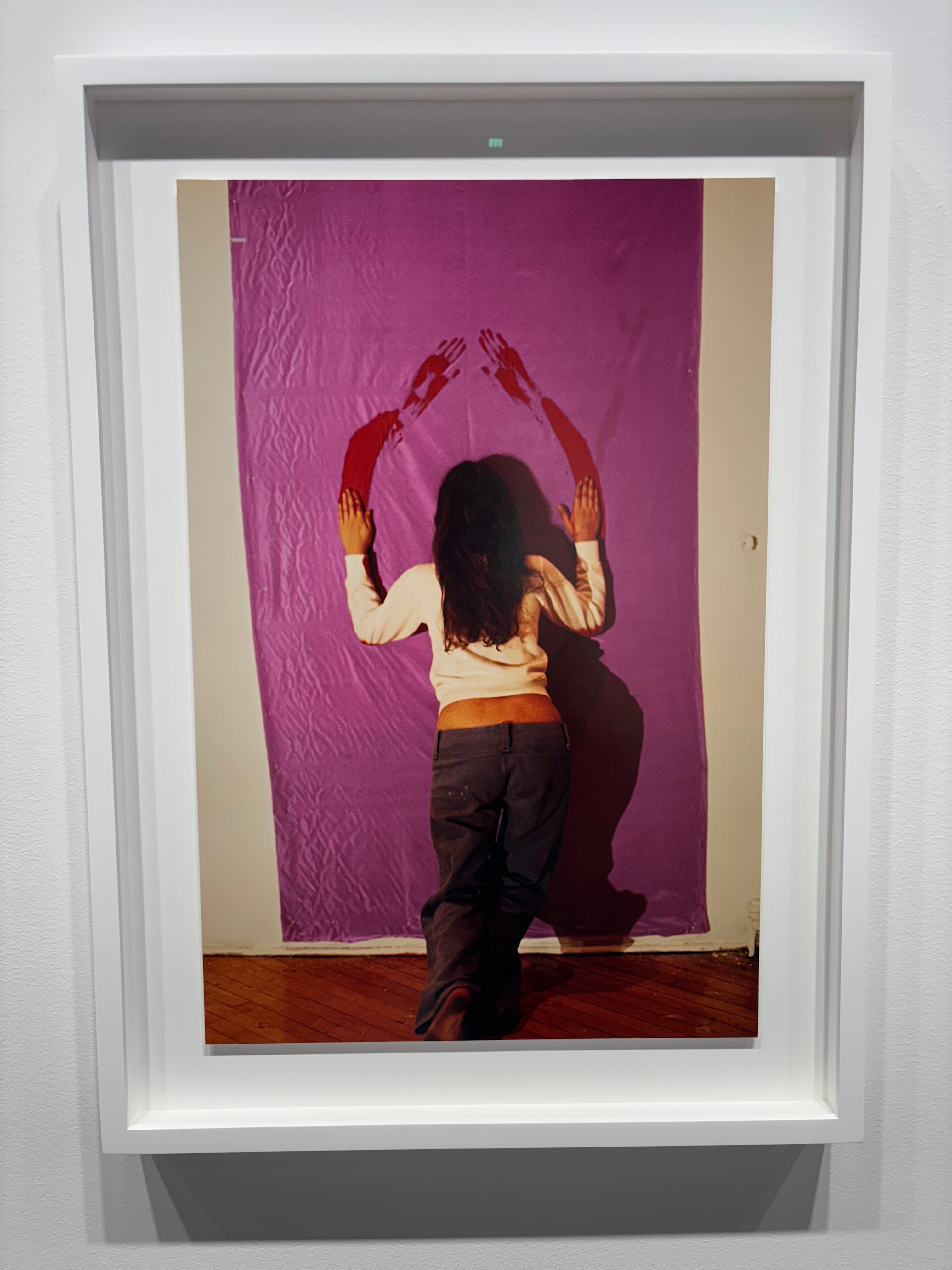
Overwhelmed with emotion at the Ana Mendieta exhibit. Or I was just a little hungover, shaky. The absence and presence of her body silhouettes, the vague shape of her body in darkened, tamped down grass, red liquid in a muddy puddle, flames and dark ash. Her body as nature—a part of it, affecting it, not distinct from it—and nature as the body. I love her certain mysticism, her belief in and trust of embodied feeling over intellect. And her devotion to the materiality of life, how she stopped painting because it wasn’t “real enough,” she said she wanted her “images to have power, to be magic,” that making itself was the experience, the art, and the photograph simply an “afterimage.”
Last night J, C, and I were talking about how we’ve all had our periods this week. “It’s a full moon,” J said. She takes medication to prevent her period because she has endometriosis, she said, but every time there’s a full moon, it comes anyway.
Wayne Koestenbaum writing about Herve Guibert in an old issue of Bookforum: “Bodies have always wanted only one thing, to be aimless.” Does writing also desire aimlessness? Does mine?
This part in the Garner diaries where she lists what her husband’s novel “cost” her, the two of them: “No piano. No holidays. No weekends. No outings. We sold my car. No river, no sea, no garden. No dog. No outdoor clothesline.” It reminds me of Kate Zambreno and Anne Boyer’s lists of what prevents writing their books. Zambreno: “The heat, the dog, the day, the air-conditioning.” Boyer: “time, … air to breathe and potable water, … a body and earth.” Is it writing that limits the freedom to live or is it life that limits the freedom to write or is it capitalism that limits the freedom of time, of both?
Anne Carson in “The Gender of Sound”: “Verbal continence is an essential feature of the masculine virtue of sophrosyne (‘prudence, soundness of mind, moderation, temperance, self-control’) that organizes most patriarchal thinking on ethical or emotional matters.” An essay I’ve always wanted to write about shyness, which is somehow also about saying too much, spilling over, saying the wrong thing. Met up with a friend I hadn’t seen in a while, and when she asked how I had been I didn’t know what to say, didn’t know how to summarize or gloss over the details or lie, so I said everything.
At work I both resented being there and felt it was utterly necessary—to be in a room with other people, to move and talk and laugh, to be a part of the actual world of conversation and eating and things. How writing has always seemed the opposite, of a different world, and I have wanted to press them together.
Last night after seeing One Battle After Another, I thought: I need to decide how I feel about this movie, what I really think about it, I need to articulate it to myself, I need to form an opinion, to understand that this is a verb, an action, and to participate in it. So often I just let my thoughts float around, disjointed, half-established. But now writing this down I find there is something compelling about the floating, wispy, untetheredness about these thoughts, these ideas which have not been made solid shapes.
Cramps down to my ankles. I do not want to work on my essay. I do not want to do anything.
What is it I love about Garner’s diaries? A clarity, a plainness. This feeling of just setting things down: objects, images, quotes, events.
H and I talk about what we’re reading together at the host stand before it gets busy. We tell each other we’ll trade Bronte sister books when we finish our respective novels; she’s having trouble getting into Wuthering Heights. I tell her about “The Glass Essay,” and we both pull it up on our phones. I take great pleasure in reading a few stanzas at a time hiding near the dish rack until my section fills up. “Give and take were just words to me // at the time. I had not been in love before. / It was like a wheel rolling downhill.” Quoting this poem always ends up a little disappointing; to cut a few words from the vibrating expanse of the whole seems disloyal, a misrepresentation.
Someone on the train playing nature sounds from his phone. Little birds chirping at 1:30 in the morning underground.
Maybe I need to just say it was a nice time instead of picking everything apart. I had a nice time. Sitting on a barstool, drinking my favorite cocktail, talking very loudly to be heard over the Saturday night crowd. Men in beautiful collared sweaters. When A showed up with P we chatted about nothing in particular. I am so much taller than both of them. I slouched. I took off my sweater and told them how earlier a man had said my floral shirt was “perfect for the day,” and I’d said, “ok,” but I had no idea what that really meant. None at all. While waiting for them to arrive, I’d read an essay by Naomi Klein about the Surrealist movement and fascism, and incited the little electric hooking on feeling of intellectual stimulation. She writes of the excesses of Surrealism, how a movement often perceived as something otherworldly, beyond or separate from real life, was in fact “a fervent and collective quest for the very essence of life.” The Surrealists’ ongoing attempts to both realistically depict and ideologically subvert the horrors of their moment in history by experimenting with a wide variety of genres and styles, mixing them together, conversing and debating and collaborating, trying and trying again. “We can learn from how they tried to not only be antifascist, but be the antithesis of fascism.” Scattered candlelight, damp coasters, the barren disarray of a night becoming late. A laughed and clapped her hands together in that way she does that is particularly hers, the sound wide and hollow.
For a while I thought working in restaurants, though it may have been at odds with my writing, was essential to my living. There were people there, and levity, and I feared if both my writing work and my job were solitary or intellectual or sedentary, I might lose track of the real, accustomed and comfortable as I was to being buried deep inside my own head. It’s not that I don’t feel this way anymore; more that restaurant work only becomes increasingly untenable in the long-term—physically, financially, etc. At odds with my living.
At the Alex Katz exhibit in Chelsea, noticing a few stray drips of orange paint on the otherwise solid shapes, white canvas, I find myself thinking I’d like to read what someone else has to say about this. Is what I want from art context, explication, language—sort of the opposite of art? The desire to, in some sense, apply the experience of art, the seeing, to my life?
The Christmas tree is up at Grand Army Plaza, glowing in the thin blue air, frigid dusk. Blue and green lights, and a darker red whose brightness is stifled among the cooler shades. A leaky white star. Winter’s barren shapes and edges, nakedness, transparency, nothing filled-in. At the library I drop the brick-sized collection of Helen Garner’s diaries, which has accompanied me for months now, into the return slot, and feel sad.
Love this! And I love the "floating, wispy, untetheredness about these thoughts, these ideas which have not been made solid shapes." It's honest and real and yes, compellling. Thanks for sharing:)