May Interruptions
I’ve been feeling like my life is falling apart, which means I haven’t been writing. I forget what these roundup posts were supposed to be—what interrupts what? What is interruption and what is the thing being interrupted? Was making pie an interruption? Was taking a photo of the ground-level subway station in the sun, lines and wires in the clear light, industrial angles, an interruption? Was buying my best friend’s new baby a Backstreet Boys onesie an interruption? Or briefly lapsing into the memory of the two of us a very long time ago on a swingset in Idaho yelling the words to “Larger Than Life” into the open whooshing air? Was going home early an interruption? Was declining an invitation to meet a friend after my shift, instead taking the train home, washing my face, brushing my teeth, going to bed, waking early the next day to read, to finally sit down and write this, was writing this an interruption?
May was lurching and happened—my friends opened a bar, my mom came to visit, I moved to a whole new neighborhood. My careful schedule shifted, scattered, and I tried to recalibrate. The desire for a clear smooth container of time—to write in a separated, cordoned-off space in which I can be very quiet and very still. And the attendant realization that writing can happen in-between, too. A few days ago, taking the train way out into East New York, walking along the highway, past the auto shops, the cemetery, how lateral and sprawling this part of the city felt, faraway and the clear light and saturated outlines of the clouds touching all the way down to the sidewalk. I was in the middle of a very long day, but I was reading Lisa Robertson’s Riverwork, and thinking about movement and pauses and notes, a great confusion of interweavings. “The premise here is that nothing happens. There is no resolution. Things disappear. The earth changes. I wake up to write. I’m crumbling in tandem with a world. This is abundance.” But that happened later.
I often come back to this idea, something about note-taking, about writing alongside living, about writing in between working and cleaning and eating meals with friends, but there is always the lingering sense that this is only the preliminary work—the gathering, or gleaning, per Agnes Varda—and the real work of coherence comes later, in that container of duration and uninterrupted quiet. What is writing? These hapless, meandering notes or making a shape of them? But the other day I was so busy, taking the train from one neighborhood to the next, walking and walking, buying bottles of club soda and hurrying, and I thought the whole day would be lost but waiting on the subway platform I read: “How can I, a good enough cleaner, ever presume to speak of [thinking]? But it is to me the only topic.” and at the intersection near work where the light takes so long to change and the two-way bike lane is always crosshatched with electric bicycles affixed with vinyl rectangular containers, I wrote: “People carrying paper bags, wearing red shoes.” and “To be walking through the city thinking.”
📚 Wrong Is Not My Name by Erica N. Cardwell
“Rather than looking closely, why not look around?” writes Erica N. Cardwell in Wrong Is Not My Name, a collection of essays about art and family, which I read early in the month. A blend of criticism and memoir, which utilizes the latter to question, define, and sharpen the former, the book has a multidirectional gaze that feels both capacious and refined. It is both astute art criticism and it is about art criticism; it is a personal narrative of grief and love, and it is also about personal narrative. Form itself and also an inquiry into that form. The essays expand, propelled by an ongoing movement which does not travel exactly forward but does not stop.
📚 Margaret and Dusty by Alice Notley
I loved these Alice Notley poems, originally published in 1985, which are chatty and frank and sassy, attached to a distinct (if at times contradictory, diaphanous) “I” who is always in conversation with some indeterminate “you.” Notley always seems like a poet who manages both total irreverence in her work and also simultaneously the opposite—a sort of mystical, otherworldly, total devotion. I have not read nearly enough Notley to have much to say about her, but I took a photo of these lines in my library book the other day, while reading at the park and thinking distantly about all the dog pee I was probably sitting in, and they seemed important to my understanding of what little I have read of Notley’s oeuvre: “I don’t want there to be any secrets told. / Instead how my shoulder feels when I turn this corner of / the left or whatever, finally to say that.”
📚 Shit Hike by Callie Garnett
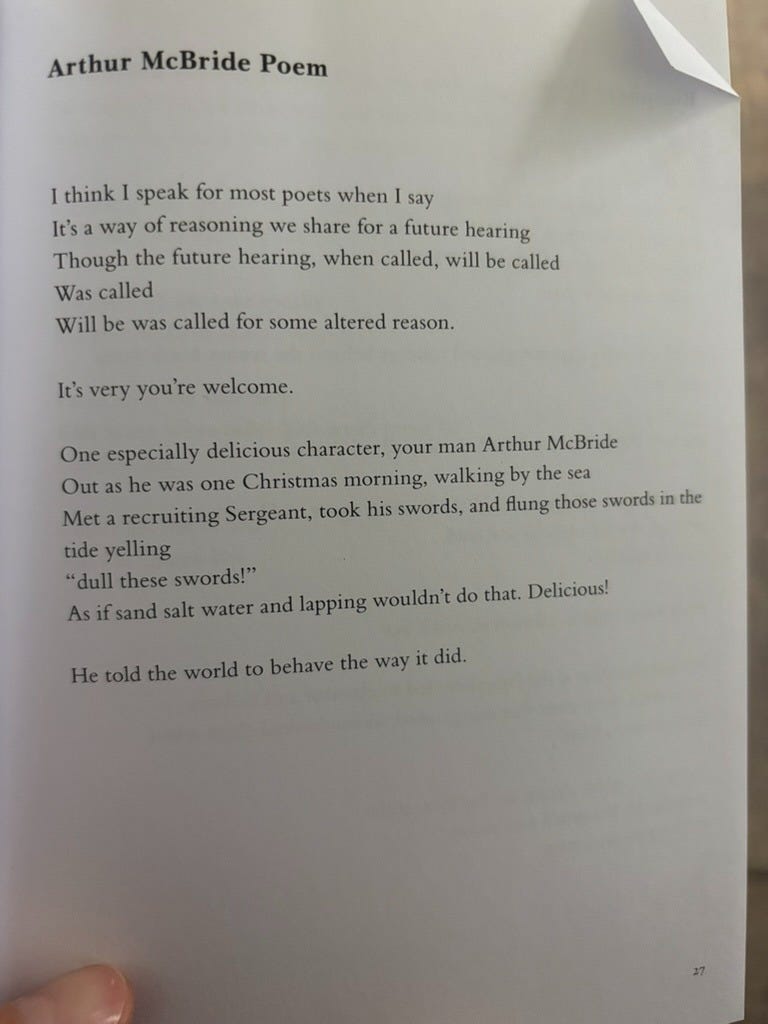
I have read a couple of poetry collections published by The Song Cave recently, and have found they all share a similar aesthetic—admittedly, they are all written by young-ish white women, so perhaps that also contributes. These poems are funny and tangential and fine. Halfway through the book I felt very annoyed by all the blooming bursting wryness, Garnett’s long lines and gapped syntax and sentences so committed to absurdism they leaned nonsensical—words mean things!! You can’t just say stuff!! It’s not funny anymore!! I was having a minor meltdown. I had been thinking about AI and had just read several essays on the Granta debacle, in which a story likely written by AI was awarded a prize by the prestigious magazine for its “lyrical precision” and “richly evocative” language. The sentence people keep citing (I have not read the whole story and frankly I do not plan to!) broke me and reminded me of graduate school and thus broke me further: “They called her Zoongie. Maybe it was a name; maybe rain took a shape and decided to keep it. She had the kind of walking that made benches become men.” I mean?????
Anyway, I calmed down about that and read this poem, which felt like an opening, and in the end I liked the book but did not love it like I loved this one poem:
📚 The Taiga Syndrome by Cristina Rivera Garza
Every book published by Dorothy is my favorite book, and this was no exception. The story is told by a detective who’s been hired to track down a man’s wife after she leaves him for another man and also possibly a remote forest and possibly a supernatural creature and possibly illness or madness or something, it is unclear. Rivera Garza’s prose is atmospheric and haunting, the story of telling the story as important to the plot as the events themselves. “What is between imagining a forest and living in a forest? What brings together the writing of a forest with the lived experience of a forest?”
📚 Transcription by Ben Lerner
I love Ben Lerner and I love books about thinking and talking and the swirling, expansive paths these things take! My preferred Lerner remains 10:04, but I enjoyed this.
📚 After Claude by Iris Owens
Once in graduate school, my friend told me our professor had told him that he used “humor as a defense mechanism” in his poetry, which is something I think about a lot because I love humor and actually I think utilizing it as a defense mechanism is not a detrimental literary or psychological tactic but actually sort of the whole point. Harriet, the narrator of After Claude, is sarcastic and abrasive and kind of obnoxious, desperately trying to manipulate her boyfriend into staying with her, both seemingly due to her own vague codependence, and also because of the material assets he offers her—if they break up, where will she live? The novel begins with this perfect sentence: “I left Claude, the French rat.” But in fact, she has not left him; even when the two eventually are separated, it is only by force and financial incentive. Harriet, in fact goes to great lengths to stay with Claude, the French rat.
There is a sort of thinness to Harriet’s persona, which her blunt sense of humor exposes. Her tone is frank and confident, haughty and condescending—“His distortions, the lies he was telling himself and me, filled me with a cold fury, because, as an American, my war against injustice knows no bounds.”—but then why does she stay with him? I guess it could be argued that she does so purely out of economic necessity, but one wonders how it’s possible a woman who purports to be so clever and resourceful can’t hold down a job or a roommate, can’t charm some other man. “After Claude,” writes Emily Prager in the introduction, “is definitely a meditation on the ends to which intelligent women will resort not to use their intelligence.”
The plot twist at the end, which I will not spoil here because I need all of you to read this and then report back to me, threatens to break down Harriet’s witty persona entirely. It is an astonishing turn of events, one that calls into question most of the events that came before it, not to mention Harriet’s acerbic witticisms about them. I kept thinking about control and freedom, how sharp and condescending Harriet can be, how she manipulates the narrative with cutting insults and snarky comedy—until she doesn’t.
I often think of humor as being a particularly obvious defense mechanism, one which is constantly in danger of crumbling. In one scene between Harriet and Claude, she “reached up and grabbed his arm, clinging to it as though it were the overhanging branch between me and the fatal drop.” As Prager observes, Harriet often acts as though, despite her endless lamentations, she would not be able to live without Claude. Prager writes of the particular “predilection of bright women to twist themselves into bizarre submissive postures from which only humor can release them.” There is a sort of helplessness to humor—a resignation—that Prager is getting at here. All these intelligent women know they are participating in their own debasement, understand the mechanisms that produce such dynamics—and yet cannot or do not quite want to stop. A sort of helplessness or inevitability sets in within their own self-inflicted (or condoned) abjection—it is embarrassing, and it is worse to know it is embarrassing. But what is there to really do about it? Humor defends from the stagnant acquiescence and assumed ignorance of submission while simultaneously submitting. I don’t think she is really defending herself against the situation itself though; more so I think what humor protects here is her own idiosyncratic acuity within such debasing circumstances—that even deep within this submissive role, she has something to say about it.
🎥 No Picnic
It was a bad month for movies, but I saw this 1986 Phillip Hartman movie with Heather at Film Forum earlier in the month, when it was just turning undeniably warm and the evening we walked into was tinged with pink and impossible atmosphere of collective contentment and voluptuous potential that’s somehow both containing, held-in, and also unraveling and totally free. Anyway, No Picnic is a movie about what Heather and I talked about later in the reddish light of the nearby bar we’d finally decided on, choosing a post-movie venue always such an absurd but irresolvable calamity—there are so many bars in New York, but of course we can’t just go to any bar!—the momentum of the city, how it just keeps going and going and nothing is all that precious, no plot is particularly essential, no idea is central, things happen and they pass, death happens, life happens, keeps happening. In New York you’re always closer to death than you are in most other places, but of course you’re also, therefore, closer to life.
🎨 Suspending Time, Jess Allen
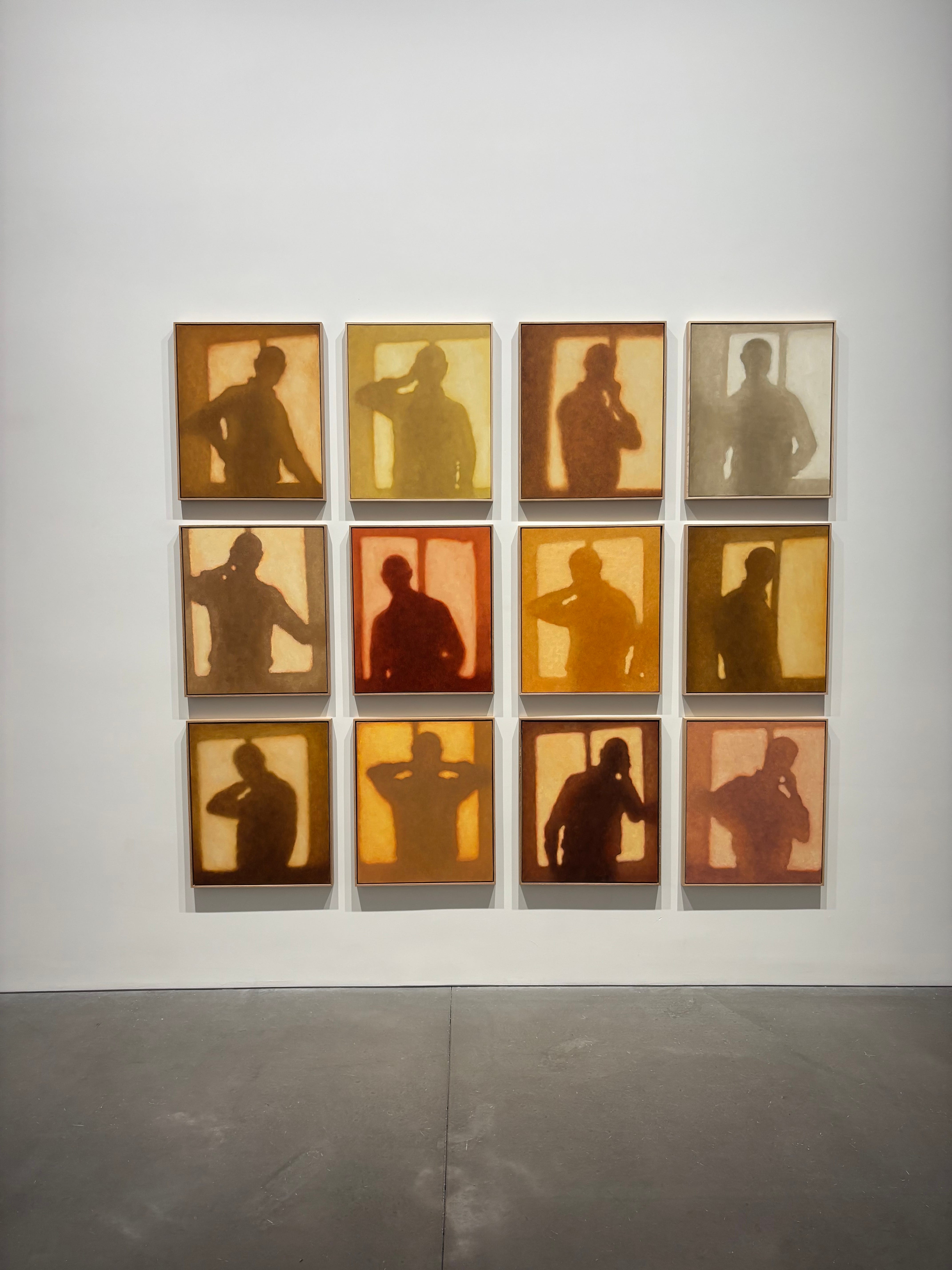
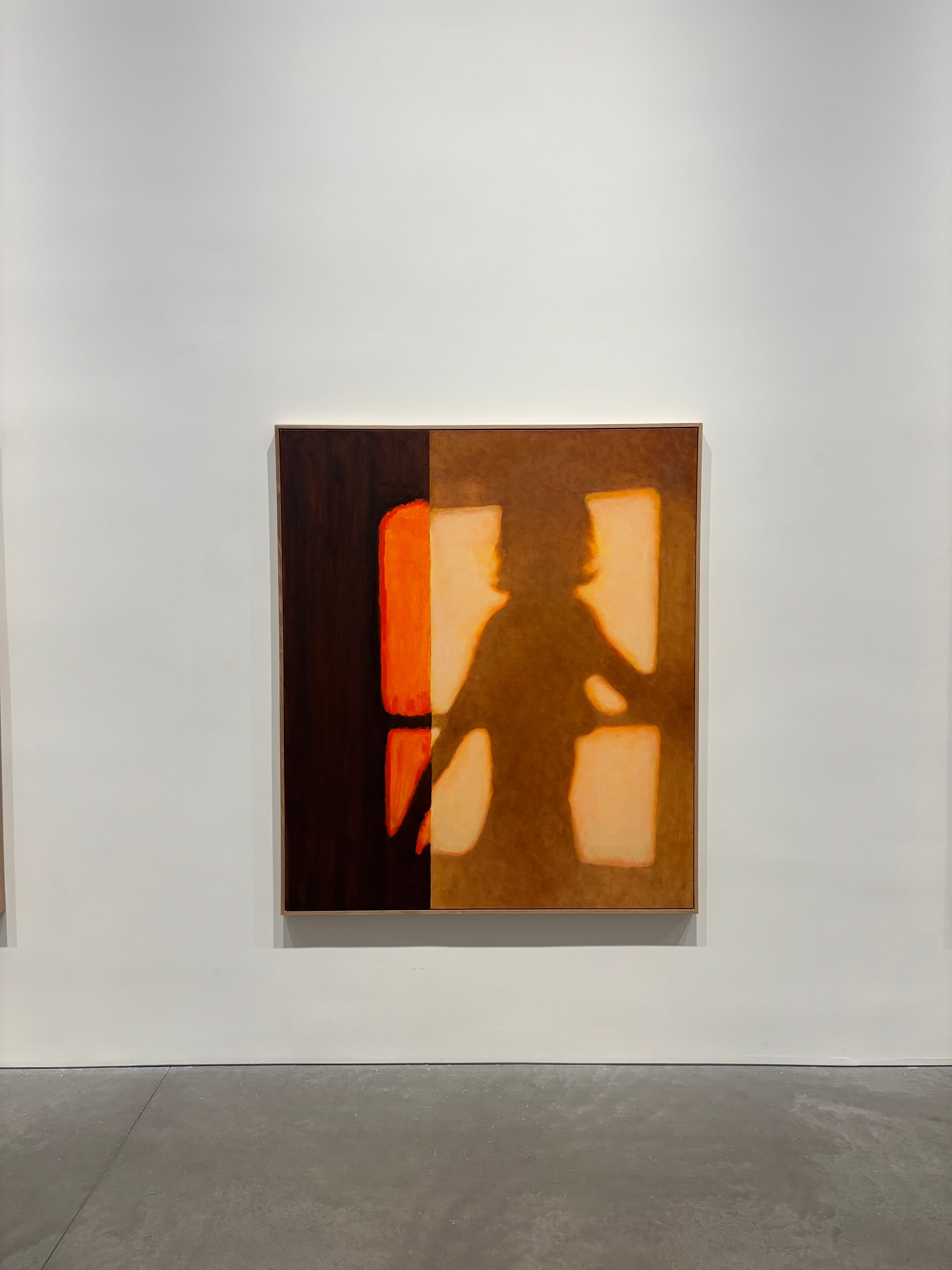
I went to Jess Allen’s solo show at Nino Mier Gallery in a spare hour between writing and work, the still-revelatory realization that I could really just do that—hop on a train, walk through SoHo, enter an art gallery despite its intimidating minimalism and clean white walls. The show features a few series of paintings by the UK-based painter, all of which share a warm color palette—orange, bronze, yellows, shades of heat and light I have so often tried to describe: rusty, pennied, warm, or failed to describe. I was reminded of a photograph I had taken of the Empire State Building months ago, glowing in the late afternoon sun in such an uncanny way, and then I thought too of Edward Hopper’s paintings of New York City rooftops, those similar shades of evening. Intimacy and distance, is what I wrote down, unsure how to quite explain this. There are two series in which a silhouette is seen framed by a window, the figure painted in different poses, sun and shadow moving variously across the canvas. The intimacy of seeing someone through a window, gazing in on the machinations of their private life, and the uncrossable distance between viewer and viewed, between one person and another. Is it that this sort of looking—without knowing a person or pretending to know them or trying to know them—makes intimacy so overtly farcical? That it makes intimate the distance between us?
Excellent.